Friday, October 14, 2011

Low tide Luring

There is nothing more rewarding when fishing then having the right lure in the right place and at the right time. While soft plastic fishing for flathead, lure, time and location are the three factors that can make the difference between not catching fish and that flathead of a lifetime.
My favourite tide for to fish an estuary can range from the last three hours of an outgoing tide, to 1 hour after the tide changes and starts coming in. This is purely because flathead are ambushing predators which camouflage themselves under the sand and wait till there food passes by, usually due to the drop in water height. Many people make the mistake that all the fish are feeding on the high tide and also make long and pointless casts past the feeding fish which are often at your feet.
A solid flathead taken on a soft plastic at Lowtide
My mate and I were at our local estuary system, bright and early in the morning, just before the tide started pushing in. the general underwater landscape is sand with rocks spread throughout the creek bed. When fishing these snaggy areas I usually turn to my No.1 softplastic, the Storm Twitching Nipper.
In no time, after the first few casts, I had hooked up on a nice fish which appeared similar to a whiting as it darted through the water. The fish was landed on the sandy bank after making a few spectacular jumps and turned out to be a nice giant herring. These being uncommon at this spot but more likely found in the dreams of many saltwater fly fishermen. The fish was released without harm after a couple of quick pictures.
Only a few casts later I tried to let the lure sink down between the rocks on the sandy bottom. As I twitched my little nipper and let it fall back down, the slightest tug pulled my line so I lifted my rod to hook the fish. At first it felt like the I had hooked into a solid rock until it zigzagged through the water and shot off towards the rocky wall. The fish put up a good fight pulling the line of my Okuma combo every time it raced towards the barnacle and oyster encrusted rocks. I eventually slid the fish into a shallow section where I used my Okuma Lip Grips to get a good hold on what turned out to be a sizable flathead.

While in the lip grips, I supported her belly and took her over to out gear for a few quick pictures. The fish measured 60cm, was tagged and released with no dramas.
The Nipper munching flathead before being released.


As the tide crept in and the number of bait fishermen turned up to feed the fish, more time passed between bites. A similar thing happened to me on the other side of the creek about 20 minutes later. I let the lure sink down and gave it a few sharp twitches. This time it resulted in a nice 50cm dusky flathead which was also tagged and released.
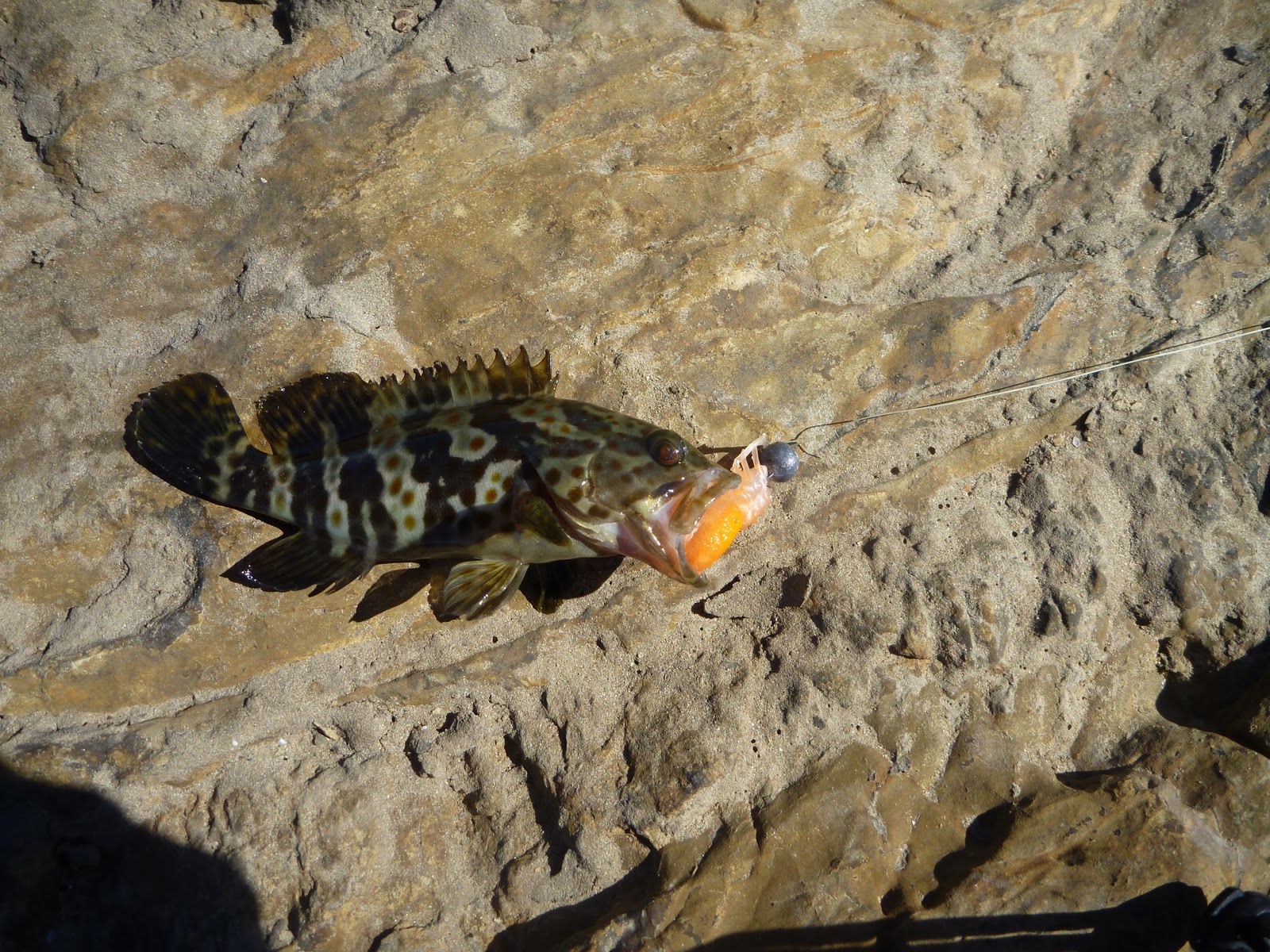
My mate finally caught on to the Storm Nipper concept and managed to land a nice little giant herring on the pink variety of the lure, after changing from hard body. I managed to hook up on a couple of small goldspot rockcod off a rocky ledge.
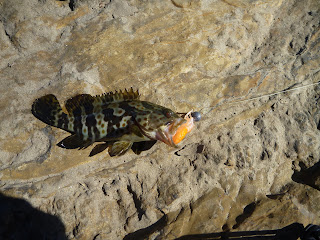
little cod like this will hit lures quite large for them
My chosen tackle for this type of fishing is my Okuma graphite Travel rod and the Okuma Flame 30 reel spooled with Sufix Duraflex line.

Sufix Duraflex monofilament

The little Storm Nipper proved it’s worth once again with a few great catches throughout the day. If you are one of those keen flathead anglers, or are new to the soft plastic revolution I suggest you get a packet of these for your tackle box as it just might catch that fish of a lifetime.


Sunday, October 2, 2011

Fishing the Snags

Shortly after my mates and I planned a last minute fishing trip to our local Fitzroy River in Rockhampton, we headed down to Barra Jacks, a nearby tackle store. As the store didn’t have in stock any of the Floating Rapala X-Rap 10 lures I resulted to one of the new Storm lures to the store. This lure being the Storm Thunder Barra. This lure is 11cm long, dives to 2 meters, weighs 21.5 grams and has a positive buoyancy which is great for casting into those snaggy and hard to reach areas. The two lures I bought were the olive scale and the pop eye coloured Thunder Barra’s.

The Storm Thunder Barra Lures
 We then headed down to my mates favourite spot at the river where we threw our lures over the rocky structure. The water surrounding the spot is full of rocky holes which can be challenging to fish without the use of floating lures.
The rocky structure at our river

Within the first three casts of the Pop Eye coloured lure I was hooked up on the first fish of the day. Even though the standard wind in retrieve can produce bites, a strong twitch retrieve with many pauses can cause the barra to stir into a feeding frenzy and smash your lure as it darts past. The fish stood no chance against my Okuma V-System baitcaster reel and Okuma Graphite Travel rod combo as it shot through the water.

My Okuma V-System 200a reel and Okuma Graphite Travel rod
In no time it was landed and safely held by my Okuma Lip Grips. The fish was tagged and released after a few quick pictures.
Another tagged barramundi
As the day progressed I switched to my suspending Rapala X-Rap 10 lures in the hope that they could entice the barra from their rocky holes. I now regret it today as suspending lures tend to be less snag resistant, unlike the more buoyant floating lures. With this in mind I hope that other keen anglers learn from this and stick to floating lures while fishing the snags. I also recommend any extreme barramundi fishermen to go get a few Storm Thunder Barra lures for your tackle box, as it just might be the difference between catching nothing or that fish of a lifetime.

Sunday, September 18, 2011

Estuary fishing

Estuaries can be a productive fish community, with numerous targetable species from flathead to barramundi. While many estuaries can’t easily be fished without a boat, or kayak, low tide can be a peak time for land based anglers.
While on a treck through my local estuary system, at lowtide, with my fishing companion Daniel, we aimed to spend the day throwing soft-plastics at the snags and over the sand flats. The tackle I was using was my Okuma graphite spin Travel rod with my Okuma Flame 30, which was spooled with Sufix Duraflex line. Spin combos are the best light gear for this type of fishing.
We started 2 hours before the peak of low tide and walked our way through a system of shallow creeks. My lure of choice was the Storm Wildeye Twitching Nipper, which produce most bites in the pearl colour. The main technique with these soft plastics is to cast them into the snags, let them sink to the bottom, then give them a few sharp twitches, before repeating this process. The key to this technique is to watch your line. Most fish strike on the pause or when the lure falls, so if you see any slight tap on the line as the lure sinks, strike to hook up the fish.
While using this method in the upper reaches of the creek, we hooked up on a few nice flathead, which were sitting in the sandy patches, waiting for an unsuspecting baitfish or yabby to wonder by. The flathead ranged from lengths of 30cm, through to the tougher 55cm specimens that lurked over the sandy creek floor.
The snags were only about 5m away from our feet in some areas, which made casting a breeze, though the tannin coloured water minimised any vision of the fish.

As well as flathead, we regularly hooked up on goldspot rockcod, which were more commonly found in the mangrove roots and timber structure. These fish seemed to vary in colour and patterns throughout the species. I caught these two goldspot rockcod off the same snag and they displayed two very separate colourations.

While Dan and I walked across a sand flat covered in potholes, Daniel offered to show me a magic trick. He handed me his rod, bent down and pulled a large male mud crab out of a pothole. We tied it up and threw it in my backpack.
At the last creek, we had been casting for a while without much success. The creek was a bit wider than the others, so it was a bit harder to get the lure closer to the snags. I waded out as much as I could, and casted the lure, which landed just off the roots of a big mangrove snag. I gave the lure a quick twitch as soon as it hit the water and waited for it to sink. The lure didn’t sink though, so I whipped my rod back and felt quite a weight on the other end of my line. The fish crisscrossed through the water and pulled heaps of line of my Okuma Flame 30 reel. The fish turned out to be a Queenie, put up a hell of a fight and didn’t surrender one bit. Even though it was landed and in my hands it kept flopping about. This proves that the Storm Twitching Nippers can really catch any estuary species. The Queenfish was released after a couple quick pictures and we started to head back before the tide came in.
We casted along the snags in a few of the last creeks for a while, where we hooked up on more flathead, rockcod and even a few barramundi.
 Daniel hooked a 30cm cod, and while bringing it in, a huge dusky flathead smashed it in the shallows and tried to engulf it. All the fish were tagged and released, but I can’t wait to get out there again and hopefully catch that monster flathead.


Sunday, August 14, 2011

Coromandel Bay Snapper


While on a trip to New Zealand, we stopped at Coromandel Bay, where we were taken fishing by the Mussel Barge Snapper Safaris. We left in a group of around 15 and travelled out into the mussel farms where we bottom fished using baits like squid and cubed pillies.

My first Snapper

Within about 10 seconds of our baits hitting the bottom, we were pulling up snapper like there was no tomorrow. My first snapper, being the biggest of the trip ate the tinnies chunk of pilchard, but then again elephants do eat peanuts. 

Dad's Snapper

After about half an hour the fishing had settled down a little, so I threw out a whole squid which hooked up onto a beast of a fish. The skipper called it for a kingfish, but in no time the fish pulled me into the mussel farm and broke off my 15kg line. Other than snapper, we managed to catch plenty of little yellowtail, Aussie salmon, a couple rat kings and small shark.
The tackle usually associated with snapper fishing is a spin combo, like the Okuma Trio or V-System spins, but with snags 7 meters on either side of us, we had to beef up our gear in order to land the fish.
Dusk at the mussel farms


All in all, the day was packed exceptional fishing. The fish weren’t necessarily huge, but they were great fun. Next time you’re in New Zealand, drop into, Mussel Barge Snapper Safaris; it is as cheap as $50 for a fishing adventure of a lifetime. 

Tuesday, August 2, 2011

Rapala Clackin Series Review

When hardbody fishing, there are four factors that influence the success of your lure. These are the size, colour, action and sound of the lure.  No lure range has displayed each of these features like the Rapala Clackin Series.

The Clackin Series

After the successful introduction of the Rapala Clackin Rap in 2009, Rapala released the Clackin Crank and the Clackin Minnow early this year. These unique lures feature metal disk side plates on either side of a single steel ball in their rattle chambers which make a loud cadence rattle. This is because metal on metal travels much further underwater then metal on plastic. Other features across the range are the textured translucent bodies with an internal holographic foil, VMC black nickel and Sureset Hooks and 3D holographic eyes.
The Clackin Rap
The Clackin Rap comes in a 6cm and an 8cm model, the Clackin minnow comes in a 7cm and an 11cm model while the Clackin Crank comes in a 5cm model. The lures are featured in the majority of the colours as the X-Rap slash baits.
The Clackin Crank
The Clackin minnow and crank both feature a square bibbed design, which gives the lure a seductive body roll and also deflects snags. The Clackin Rap is a bibles crankbait which tends to be more snag resistant then standard sinking, bibless hardbodies.

Kayak Fishing for Barra with my Clackin Minnow
These lures are great for a whole range of salt and freshwater species from murry cod and yellow belly in dams and river, to flathead and barramundi in the estuaries. I recommend getting a couple for your tackle box, so next time you have a cast for that fish of a lifetime, you have 100% confidence in your lure. 

A nice Flathead that ate my Clackin Rap